You’ve probably used ChatGPT to write emails or summarize documents. That’s generative AI. But lately, there’s a new buzzword everywhere: agentic AI. And no, they’re not the same thing.
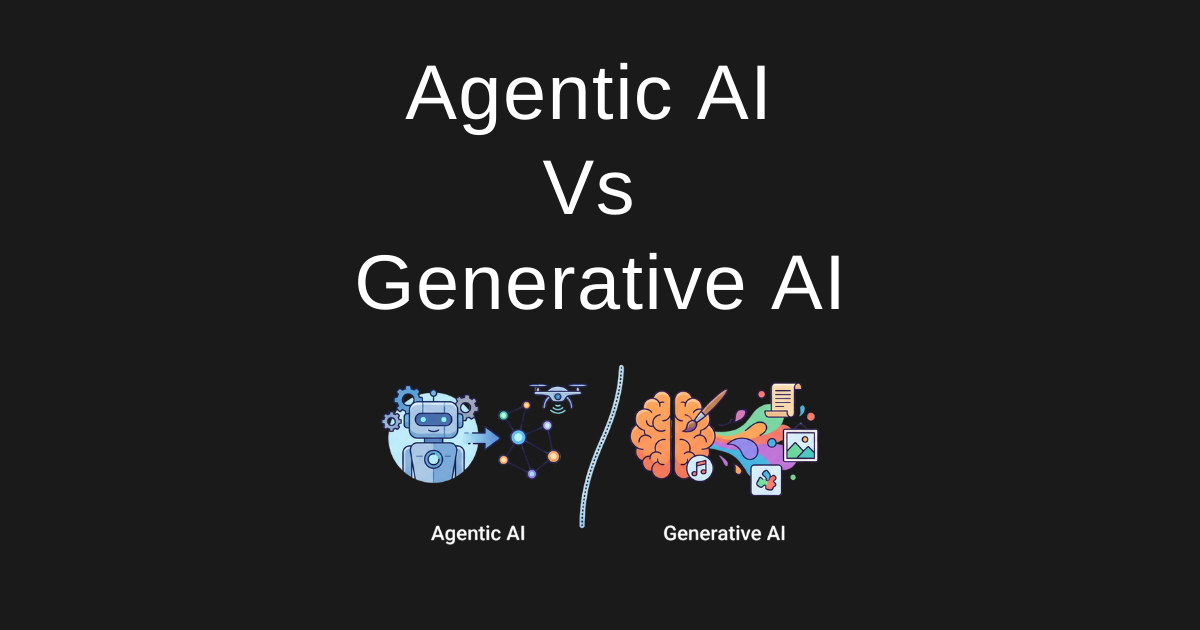
Here’s the simple difference: Generative AI creates stuff. Agentic AI does stuff.
One writes your email. The other sends it, schedules the follow-up, and updates your CRM — without you lifting a finger.
What Is the Difference Between Agentic AI and Generative AI?
Let’s break it down with a real example.
With generative AI: You type: “Write a follow-up email to Sarah about our proposal.” → AI writes the email. Done. Now you copy it, paste it into Gmail, and hit send yourself.
With agentic AI: You type: “Follow up with Sarah about our proposal.” → AI writes the email, sends it from your account, checks if Sarah replies within 48 hours, and pings you if she doesn’t.
See the gap? Generative AI stops at content creation. Agentic AI keeps working until the job is actually finished.
Quick Comparison: Generative AI vs Agentic AI
| Feature | Generative AI | Agentic AI |
|---|---|---|
| What it does | Creates content (text, images, code, audio) | Completes tasks and achieves goals |
| How it works | Responds to your prompts | Plans, decides, and acts on its own |
| Human involvement | Every single step | Only at the start (and maybe end) |
| Memory | Usually forgets between sessions | Remembers context across interactions |
| Tool usage | Limited or none | Connects to emails, calendars, databases, APIs |
| Best for | Content creation, brainstorming, drafts | Workflow automation, task completion |
| Examples | ChatGPT, Claude, DALL-E, Midjourney | AI sales agents, autonomous customer support bots |
The Numbers Tell an Interesting Story
Both markets are exploding, but at different stages:
Generative AI (the established player):
- Market size: $22.21 billion in 2025, projected to reach $324.68 billion by 2033
- Companies spent $37 billion on generative AI in 2025, up from $11.5 billion in 2024 — a 3.2x year-over-year increase
- 92% of Fortune 500 companies leverage OpenAI’s technology
- ChatGPT’s weekly users exceed 400 million, representing 4x growth in 15 months
Agentic AI (the fast-growing newcomer):
- Market size: $7.55 billion in 2025, projected to hit $199.05 billion by 2034 at a 43.84% CAGR
- 45% of Fortune 500 companies are actively piloting agentic systems
- Agentic AI can reduce human task time by up to 86% in multi-step workflows
- Agentic systems can complete up to 12 times more complex tasks compared to traditional LLMs
The adoption numbers are particularly telling. 79% of organizations report some level of agentic AI adoption, with 96% planning to expand their usage in 2025.
How Generative AI Actually Works
Generative AI learned from billions of documents, images, and code samples. When you prompt it, it predicts what should come next based on patterns from training.
Think of it like autocomplete on steroids. It’s incredibly good at:
- Writing first drafts of anything
- Summarizing long documents
- Translating between languages
- Generating images from descriptions
- Writing and explaining code
But it has one big limitation: it’s reactive. It waits for your instruction, produces output, then stops. It can’t check your calendar, send an email, or book a meeting. It just creates content and hands it back to you.
How Agentic AI Actually Works
Agentic AI wraps generative capabilities inside an action loop:
- Perceive — Gathers information from its environment (emails, databases, APIs)
- Plan — Breaks your goal into smaller steps
- Act — Executes those steps using connected tools
- Learn — Adjusts based on what worked or didn’t
Here’s a real-world scenario:
You tell an agentic AI: “Book me a flight to NYC next week under $500, no layovers.”
It will:
- Search flight databases
- Compare prices and schedules
- Check your calendar for conflicts
- Book the best option
- Send you the confirmation
You didn’t guide it through each step. You gave it a goal, and it figured out the rest.
Where Each One Shines
Generative AI use cases:
- Marketing content at scale (blogs, social posts, ad copy)
- Email drafts and customer response templates
- Code generation and documentation
- Image and video creation
- Research summaries and analysis
Agentic AI use cases:
- Customer service that actually resolves issues (not just answers questions)
- Sales outreach that sends, follows up, and tracks responses
- Supply chain optimization with real-time adjustments
- IT operations that detect and fix problems automatically
- Personal assistants that manage your calendar, emails, and tasks
Coding moves from a point solution to an end-to-end automation category, with the market jumping from $550M to $4B in 2025 — largely because AI can now interpret entire codebases and execute multi-step tasks.
Can They Work Together?
This is where it gets interesting. The most powerful AI systems combine both:
- Agentic layer handles planning, decision-making, and execution
- Generative layer handles content creation and communication
Imagine an AI sales assistant that:
- Identifies promising leads (agentic)
- Researches their company (agentic + generative)
- Writes personalized outreach (generative)
- Sends emails at optimal times (agentic)
- Adjusts messaging based on responses (both)
That’s not science fiction. Companies are building this right now.
The ROI Question
Here’s what the data shows:
Companies report average returns on investment of 171%, with U.S. enterprises achieving around 192% — which exceeds traditional automation ROI by 3 times.
88% of early adopters achieved positive ROI from agentic AI, compared with 74% of organizations using generative AI more broadly.
But there’s a catch: 40% of agentic AI projects fail due to inadequate foundations. The technology works, but implementation requires solid data infrastructure and clear governance.
Which One Should You Use?
Start with generative AI if:
- You need content created faster
- You want help brainstorming and drafting
- You’re okay reviewing output and taking action yourself
- You’re just getting started with AI
Move to agentic AI when:
- You want tasks completed, not just content created
- Your workflows span multiple tools and systems
- You’re tired of copy-pasting between apps
- You need AI that works while you sleep
Combine both when:
- You need AI that communicates naturally AND executes tasks
- You’re automating complex workflows with content components
- You want maximum productivity gains
The Bottom Line
Generative AI changed how we create. Agentic AI is changing how we work.
Right now, generative AI is mainstream — nearly every knowledge worker uses it in some form. Agentic AI is earlier stage but growing fast, with enterprise adoption accelerating as the technology matures.
The smart move? Get comfortable with generative AI now, but keep an eye on agentic capabilities. The companies that figure out how to combine both will have a serious competitive edge.
FAQs
Is ChatGPT generative AI or agentic AI?
ChatGPT is primarily generative AI — it creates text based on your prompts. Newer features like web browsing and plugins add some agentic capabilities, but it’s still mostly a content generator. You ask, it answers, then waits for your next question.
What’s a real example of agentic AI in business?
Customer service bots that actually resolve issues end-to-end. Instead of just answering “how do I return this?” with instructions, an agentic system processes the return, generates the shipping label, updates your account, and sends confirmation — all without human intervention.
Can agentic AI make mistakes?
Yes, and that’s why implementation matters. Since agentic AI takes real actions (sending emails, making purchases, updating databases), mistakes have real consequences. Smart deployments start with human approval for important actions, then gradually increase autonomy as the system proves reliable.
Which is more expensive to implement?
Generative AI is generally cheaper and easier to start with — you can use existing tools like ChatGPT or Claude right away. Agentic AI typically requires more infrastructure (tool integrations, security protocols, governance frameworks) but delivers higher ROI once running.
Will agentic AI replace generative AI?
No — they serve different purposes and work best together. Think of generative AI as the “brain” that creates content and understands language. Agentic AI is the “hands” that take action. Most advanced AI systems will use both.
How do I know if my business needs agentic AI?
Ask yourself: Do you have employees doing repetitive multi-step tasks across multiple systems? Are people copy-pasting data between apps? Do workflows stall waiting for someone to manually move things along? If yes, agentic AI could help.