Content marketing has always been a grind. Research topics, write drafts, optimize for search, publish, distribute, track results, repeat. Most marketing teams spend over 60% of their time on execution instead of strategy.
AI agents are changing that equation completely.
Not chatbots. Not basic writing assistants. We’re talking about autonomous systems that research, plan, create, and distribute content without constant hand-holding.
According to McKinsey’s 2025 State of AI report, 88% of organizations now use AI regularly in at least one business function. Marketing and sales remain the top functions where AI delivers measurable revenue increases.
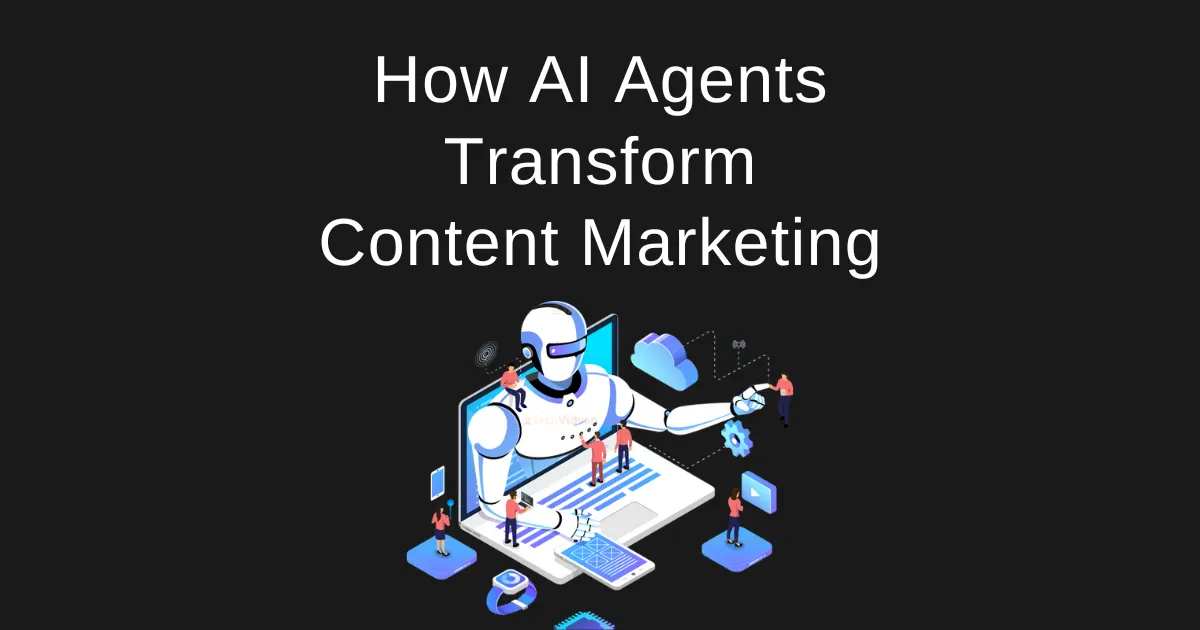
How AI Agents Transform Content Marketing
The shift happening right now is fundamental. If 2024 was about adopting AI content generation and 2025 was about no code AI agents, then 2026 is the year it all comes together.
Marketers are building entire support teams using agentic workflows. These aren’t single tools doing single tasks. They’re coordinated systems where multiple AI agents work together. One analyzes audience data. Another plans content strategy. Another creates the content. Another handles distribution.
The Content Marketing Institute puts it clearly: if you’re not implementing agentic workflows in 2026, you’ll quickly fall behind.
Here’s what makes AI agents different from regular AI tools:
Regular AI tools wait for your prompt, give you output, then stop.
AI agents take a goal, break it into steps, execute those steps across multiple systems, learn from results, and keep going until the job is done.
For content marketing, this means an agent can monitor what your audience discusses, identify content gaps, create briefs, draft posts, schedule distribution, and track performance. All connected. All learning from each other.
The Three Agent Types Reshaping Content Operations
Marketing technology experts identify three agent types transforming how content gets made:
Listener Agents These monitor customer calls, social conversations, support tickets, and competitor content. They track pain points, questions, and trending topics 24/7. No more guessing what to write about. The agent tells you exactly what your audience cares about right now.
Topic Agents These take listener insights and generate focused content ideas. Blog themes, social angles, email sequences, sales enablement materials. They connect audience needs directly to content opportunities.
Creator Agents These draft marketing assets aligned with your brand voice and what prospects are actually discussing. They produce variations for testing and adapt content for different platforms.
When these three work together, content creation becomes a learning system rather than a production line.
What the Numbers Show
The data from 2025 into 2026 tells a clear story:
Adoption is massive 85% of marketers actively use AI tools in content creation according to CoSchedule’s 2025 State of AI in Marketing Report. 74% of new websites now feature AI supported content per Ahrefs data.
Speed gains are real 93% of marketers report AI accelerates content creation. Marketing teams are 44% more productive, saving an average of 11 hours per week. Campaigns launch 75% faster than manual builds.
ROI is measurable Companies using AI in marketing see 10 to 20% higher sales ROI according to McKinsey. 41% of marketers report higher conversions through AI optimized email. Personalized emails generate 6x higher transaction rates.
The top performers pull ahead AI high performers are three times more likely than peers to scale their use of agents across business functions. These companies achieve 1.5x higher revenue growth over three years compared to competitors.
But challenges remain 70 to 85% of AI projects failed in 2025. Primary barriers: data privacy concerns (40%), lack of technical expertise (38%), and cost of implementation (33%). Only 29% of marketers have reliable attribution systems.
What AI Agents Actually Handle
Here’s what content marketing agents do in practice:
Research and Planning Analyze competitor content and identify gaps. Monitor industry trends in real time. Track audience questions across platforms. Generate content briefs with keywords, angles, and outlines.
Content Creation Draft blog posts, emails, social updates, and ad copy. Create multiple variations for testing. Adapt tone for different channels. Generate supporting visuals.
Optimization Analyze existing content for improvements. Suggest internal linking opportunities. Identify underperforming pieces that need updates. Recommend repurposing opportunities.
Distribution Schedule content across channels. Personalize messaging for audience segments. Adjust timing based on engagement data. Coordinate email, social, and paid promotion.
Performance Analysis Track engagement metrics. Identify top performing topics and formats. Generate reports automatically. Recommend strategy adjustments based on data.
The Visibility Shift: From SEO to LLM Optimization
Here’s something content marketers need to understand for 2026. Visibility is no longer just about Google rankings.
According to IDC’s research, SEO is evolving into LLM optimization. The question in 2026 won’t just be “does Google rank my content?” It will be “do AI models like ChatGPT, Gemini, and Perplexity cite my content as a source?”
IDC predicts brands will allocate 5x more budget to LLM optimization compared to traditional SEO by 2029.
Only 40% of Google searches now end with a click to an organic result. Nearly 60% are zero click searches where users get answers directly from AI overviews.
This changes what content needs to accomplish. Surface level educational content loses value. What works: original research, strong opinions backed by evidence, case studies, and firsthand insights that AI models recognize as authoritative sources.
The Human Element Gets More Important
Here’s the paradox. As AI handles more execution, human skills become more valuable.
75% of staff effort shifts from production to strategy in organizations using AI driven marketing operations. Human AI collaborative teams show 60% greater productivity than human only teams. They spend 23% more time on creative content and 60% less on editing.
The Content Marketing Institute experts say it directly: the brands that thrive in 2026 will use AI to amplify creativity, not replace it. Authenticity isn’t nostalgic. It’s strategic.
When polished content becomes easy for everyone, the competitive edge becomes judgment, nuance, critical thinking, and the ability to understand what your specific audience actually needs.
As one marketing leader put it: automation replaces execution, not taste. And in 2026, taste becomes a measurable advantage.
Getting Started With AI Agents for Content
If you’re considering AI agents for content marketing, here’s a practical approach:
Start with your biggest bottleneck Don’t try to automate everything. Pick one workflow that consumes too much time. Maybe it’s topic research, first drafts, or social distribution. Test an agent there first.
Keep humans in the loop The best results come from collaboration. Let agents handle volume and repetition. Humans handle strategy, brand voice, and final approval. 51% of marketing teams use AI to optimize content as the leading use case. Not to replace human judgment.
Invest in training Only 17% of marketers have received comprehensive AI training. Teams that invest in learning how to work with AI see 43% higher project success rates. The gap between AI hype and value centers on readiness.
Measure before and after Track your current metrics before implementing agents. Content volume, time to publish, engagement rates, cost per piece. Then measure the same metrics after 90 days. This gives you real ROI data.
Build on quality data The primary barriers to AI success are enterprise architecture problems, not model capability. Data quality and integration issues cause inaccurate recommendations. Clean data produces better agent performance.
What 2026 Looks Like
Gartner predicts 40% of enterprise applications will integrate task specific AI agents by end of 2026, up from less than 5% in 2025.
By 2028, at least 15% of day to day work decisions will be made autonomously through agentic AI, up from virtually zero today.
The Content Marketing Institute surveyed 42 experts on 2026 trends. The consensus: every content marketer needs to add AI skills to their toolbox to stay competitive. Think about what you’d automate if you had a team of interns, and start there.
The marketers in highest demand will be those who know how to orchestrate humans and machines, protect brand voice in a world of infinite content, and turn AI from a productivity tool into competitive advantage.
The Bottom Line
AI agents aren’t replacing content marketers. They’re replacing the repetitive parts that kept you from doing strategic and creative work.
86% of marketers plan to increase AI use over the next two to three years. The question isn’t whether to adopt AI agents for content. It’s how fast you can build the skills and systems to use them effectively.
The window for competitive advantage is closing. 2025 was the year AI moved from innovation labs to marketing operations at scale. 2026 is when the gap between adopters and laggards becomes impossible to close.
FAQs
What is the difference between AI writing tools and AI agents?
AI writing tools respond to prompts one at a time. You ask, they answer, they stop. AI agents work autonomously across multiple tasks. They research topics, create content, schedule distribution, track performance, and optimize based on results without waiting for your next instruction.
Will AI agents replace content marketers?
No. The data shows the opposite. 75% of staff effort shifts to strategy when AI handles execution. Content marketers become orchestrators who design workflows, set brand guidelines, and make strategic decisions. The repetitive work gets automated, not the thinking work.
How much do AI agents cost for content marketing?
Costs vary by complexity. Many teams start with existing platforms that have built in agent capabilities. Enterprise solutions with custom multi agent systems cost more but deliver bigger efficiency gains. Most companies report positive ROI within 6 to 12 months.
What content tasks should I automate first?
Start with high volume, repetitive tasks. Social media scheduling, content repurposing, performance reporting, and first draft generation deliver quick wins. Save complex creative work for human AI collaboration once you’ve built confidence with the technology.
How do I maintain brand voice with AI generated content?
Train your agents on existing content, brand guidelines, and tone documentation. Use human review for final approval. Most teams find AI agents improve at matching brand voice over time through feedback. The key is consistent input and correction during the learning phase.
What are the risks of using AI agents for content?
46% of marketers cite content quality as a concern. Risks include factual errors, generic messaging, and reputation damage from unverified content. 47% of enterprise AI users made a major decision based on hallucinated content in 2025. Keep humans in the review loop and fact check outputs.